One Thousand Scents

Friday, February 08, 2013

The Truth Dawns: L'Artisan Parfumer Seville à l'Aube


As I have said any number of times, orange blossom doesn't usually work for me: unless it is a minor player, unless it is kept in careful check by other ingredients, I nearly always find it noxious and oppressive. Like any perfumery note, it has its die-hard adherents, but with minor exceptions such as Dior's Fahrenheit 32, which adds enough vanilla to take the curse off it, the attraction of naked orange-flower has always evaded me, until now, because Seville à l'Aube — "Seville at dawn" — is ravishing. It took me a few wearings to really get it, to adjust my nose to this new experience, but once that had happened I found I couldn't get enough of it.

Seville à l'Aube is approximately a soliflore, but not a brutally single-minded one like Gorilla Perfumes' version: there is decoration and embellishment, but just enough to give it interest, to keep it from being boringly monochromatic. The top is spicy, with a splash of breezy lavender, and the base is a contrast of vanillic benzoin and dry incense, all notes that can and in this case do read as masculine (or at least unisex-trending-masculine): but they are bookends to the star of the show, an orange-blossom which seems to glint and shimmer like a diamond held up to the sun, now creamy and plush, now sharp and focused. It is the smell of pure happiness.

Seville à l'Aube is glorious, quite possibly perfect. How did I never know that orange blossom could smell like this?

Labels: ,

Wednesday, July 27, 2011

Departure: L'Artisan Parfumeur Oeillet Sauvage

Now that Serge Lutens has a new carnation scent, Vitriol d'Oeillet, on the shelves (though of course nowhere near where I can get my hands on it), I have had carnations on the brain, so it was high time I dipped into my vial of L'Artisan's discontinued and much-lamented Oeillet Sauvage ("Wild Carnation"). And what do you know? I finally found a carnation scent I don't like!

One of the things I love about the carnation is that it's so protean; depending on the company it keeps, it can be languorous (Voile d'Ete) or aggressive (CdG Carnation), needle-sharp (Coup de Fouet) or slutty (Tabu), or, by itself and unadorned, just breathtakingly gorgeous (Roger et Gallet's Carnation soap). It's a mainstay of men's scents because twined in with its complex floral heart is a bold spiciness that reads as thoroughly masculine: it's a star player in Oscar de la Renta Pour Lui, Tsar, Old Spice, and Boucheron Pour Homme, to name a few.

But of course like any perfumery element it can also be girly as hell if you treat it right, and this is the tack taken by Oeillet Sauvage: sparkle up the top notes with once-ubiquitous pink pepper, drench it in ylang-ylang and rose, and bolster the ground floor with powdery vanilla and benzoin. Any of these things by themselves aren't enough to make a carnation feminine: Voile d'Ete is steeped in ylang for that tropical feel, Old Spice has plenty of vanilla, and Carnation has buckets of rose. Oeillet Sauvage, though, has been deliberately engineered to read as a women's scent.

That's not why I don't like it, though. I wore it repeatedly and was having the hardest time articulating why it disagreed with me so thoroughly until finally I realized what the problem was. L'Artisan, always willing to take chances and to make interesting, off-centre fragrances, isn't the most expensive niche line: it's pretty middle-of-the-road, actually, with 50-mL bottles currently running about $95-$115, not horrifically more than the department-store brands (most of them $50 to $70), and as Robin of Now Smell This likes to say, $100 is the new free. The trouble with Oeillet Sauvage is that it smells cheap. Whether as cause or consequence of this, it's dreadfully unbalanced, the top clangourous with pink pepper, that and the ylang taking up far too much space, rudely elbowing aside what ought to be the clean floral spiciness of the carnation. (Voile d'Ete works its alliance of carnation, ylang, and vanilla much more gracefully.)

I mean, it's not atrocious; a fair number of people, as usual, seemed to like it just fine when it was available. But I had higher expectations from the house. My sample vial is empty, and I'm not sorry to see the last of it. If you had a yearning to try this completely unavailable scent (something which I understand all too well), you have my word that you haven't missed much, and that there are many, many better carnations out there for you.

Labels:

Tuesday, April 19, 2011

Object Lessons: L'Artisan Parfumeur Havana Vanille

Lesson 1: Be organized.

I don't know why--maybe its name came up in one of the many and varied scent blogs I read--but a few days ago I was idly thinking about L'Artisan's Havana Vanille, which was launched in mid-2009 and which was pretty obviously the sort of thing that I would love: vanilla, of course, but also tobacco and rum and tonka and and spices and a great many other things that bring me pleasure. Even though I have vowed to not buy any scents this year (a vow which I am going to break in a couple of months, about more which anon), I put it on my list of samples to order on January 1st, 2012. Later that day I was digging through a shoebox full of samples looking for something interesting to write about, and to my shock--I think my jaw fell--there was a vial of Havana Vanille which I have had for certainly a year and didn't know I owned.

Lesson 2: Don't buy more of something than you can reasonably use.

I went through a phase where I was ordering lots of tempting samples from The Perfumed Court and Luckyscent. In fact, just last week I had to stop myself from buying the newest Luckyscent sample pack, eight vials from a line called SoOud, many of which sound gorgeous. But I have got at least a hundred vials that I haven't even tried yet (see Lesson 1), and there is no way I can justify spending a single cent on more fragrances, so I exhibited an uncharacteristic strength of will and closed the web page.

Lesson 3: Don't buy full bottles of scents unsniffed (unless they're really cheap and you can live with the possibility of making a mistake).

So I put a big healthy glug of Havana Vanille on my skin and kind of hated it. I gave it some time, and my dislike was not much diminished. Imagine if I had gone by the list of notes and bought the bottle online!

Havana Vanille--already renamed Vanille Absolument--smells, obviously, like vanilla, like blond tobacco crushed together with vanilla beans in spiced rum, and even though that is a peck of glorious scents right there, it's all too much, big and heavy and sweet in a damning, overbearing way. There is a floralcy to the middle and a dusky woodiness at the base, and when you've gotten to that point the sweetness has tapered off somewhat, but it really is far too late by then: the thing has outstayed its welcome for hours. I note that some other people find Havana Vanille relatively light, and fine, everybody's nose is different, but that to me is incomprehensible: I own some fairly heavy, strong, and/or sweet scents, and Havana Vanille is right up there with them in weight and texture.

Lesson 4: Nothing lasts forever.

Vanille Absolument is replacing Vanilia, which I own, have worn for at least 15 years, and still adore (I wore it just last week, and it has never palled over the years). That's vanilla done right: stylish, graceful, perfectly unisex, a luminous concoction of vanilla pod, vanilla orchid (officially ylang-ylang, but orchidaceous to my nose), and spice, wreathed in feathery smoke. Vanilia is discontinued and is no longer on the company's website, but some online retailers still have it (you may have to hunt around), as does The Perfume Shoppe. If you love Vanilia or you just adore amazing vanilla scents (and can ignore Lesson 3), I'd snap it up if I were you.

Regarding Lessons 2 and 3, I am taking a little trip to New York in June and I am determined that the latest Serge Lutens export, Jeux de Peau, will be mine; it's meant to smell like buttered toast, and the list of notes ("Bread note, spices, licorice, apricot, immortelle, sandalwood, woody notes, amber", says Luckyscent) suggests that I will not be able to live without it, since Lutens is my obsession of obsessions. I will smell it first, just in case. But I'll do so with my credit card in my hand.

Labels: ,

Thursday, April 14, 2011

Coherence: L'Artisan Parfumeur Bois Farine

First of all, an interesting article on not El Bulli itself but its imminent closing and on the many articles that have been written about it, relevant because near the end the author says,

The Washington Post's Andreas Viestad summed up the chasm between the uninitiated and the proselytizers nicely: "This food tastes wonderful, but it is hard to find words to describe it … How can you convince someone who has never tasted tuna marrow that it is delicious?" It's a problem inherent to writing about any kind of sensory experience, of course, but at least with less experimental food, critics can assume their readership has a baseline familiarity with most of the flavors they're writing about.

That is a problem: how do you describe flavours and smells without reference to others? You have two options, I think: go off on poetic flights of fancy, or root your description in the familiar (and hope that readers are familiar with your references). I'm not a flights-of-fancy kind of guy: I can't go on about unicorns and magic-carpet rides and whatnot. I'd rather say that something smells like a tuberose wrapped in warm wool, or like Joy only not so good, and assume that you can figure out what I mean.

+

Now. If you have not heard this, then you ought to.


It isn't really called "Death Waltz", which is an actual, though deliberately unplayable, parody of sheet music containing such instructions as "with pesto" and "bow real fast (slippage may occur)" and "balance your chair on 2 legs". That thing up there is a synthesized-piano transcription of a piece of video-game music, and it recalls Conlon Nancarrow's player-piano music, though it seems clear that no physical instrument could play it: certainly no human being could. And this is what astounds me the most, what I find the most puzzling and incomprehensible: the sheer number of notes on the page, which is the thing that makes it physically unplayable, ought to, you'd think, render the composition increasingly unlistenable, because it seems as if it should dissolve into a mere blur of notes, and yet it never does. Midway through there's this alarming mass of notes

and then a bit later there's this

which soon gives way to this

with fifteen or more notes being sounded simultaneously and in frighteningly rapid succession, yet to my amazement, you can always understand exactly what is happening musically: the parts of the music, the left and right hands, the glissandi and arpeggiation, all of it perfectly clear and obvious. How can this be? Is it the orchestration, my brain, or some combination of the two? I don't know enough about music to know how this is possible, but all of the pieces fit together into a whole.

I wish that were true of L'Artisan Parfumeur's Bois Farine, but it is a jumble to me, a thoroughly incoherent and unlikeable scent. Bois Farine--"flourwood"--is based on a tree which grows only on Reunion Island and whose flowers smell like flour. The scent doesn't smell of flour, exactly, but it does start off smelling much like unsweet baked goods, no gourmandise here: the top note is suggestive of peanut-butter cookies without nearly enough peanut butter, and soon after that of stick pretzels. It isn't bready, because there isn't any yeastiness to it, but it does smell like flour-based food. And then someone goes and smashes a bottle of cheap iris cologne on the floor and wrecks everything.

There's cedar, too, and eventually some sweetness in the form of benzoin, but that men's-cologne iris: what's that doing there stinking up the bakery? It would have been possible to build some sort of bridge between the bake-shop opening and the sweetened-wood base, and it might even have been possible to do it with a floral middle, but this was not the way to do it.

Bois Farine doesn't smell like anything else, and if you like iris, then you might like this. But I just wanted it to go away. I wore it four times so I could think and write about it, and each time I felt as if I couldn't scrub it off fast enough.

Labels:

Monday, April 26, 2010

Scentroulette Day 15: Ananas Fizz by L'Artisan Parfumeur

Ananas Fizz seems to have been constructed to be cheery and fun and likeable, so why don't I like it very much?

The top is a charming, barely sweet concoction of citrus zest and pineapple, which, given the name ("ananas" is French for "pineapple"), is less a star player than I would have expected. And then it fairly quickly goes flat, joined by a cedar note which doesn't seem to fit the rest of the scent, and the pineapple takes on a synthetic quality that didn't appear at the start. It isn't objectionable or hateful, it's not a scrubber; it's just kind of blah. And for the price--currently $95 for a 50-mL spray--it's shamefully short-lived, gone in less than two hours.

Comptoir Sud Pacifique Vanille Pineapple (dense, creamy pineapple plus the usual CSP vanilla) and Demeter Blue Hawaiian (bright, chipper orange-pineapple) are much better pineapple scents, for my money. Over on Makeupalley, Blue Hawaiian, despite being the least expensive of the three, gets the highest rating, and I would have to agree: it has the usual Demeter longevity, which is to say very little, but it lasts just as long as Ananas Fizz and is fresher and cheerier, and at that price ($6 for a half-ounce splash, $20 for a one-ounce spray) you won't mind reapplying every hour or so. If you want one that lasts, and have a taste for that CSP brand of rich sweetness, then try Vanille Pineapple; it goes for hours and hours.

Labels:

Friday, June 19, 2009

Act One: Caron Eau de Reglisse and L'Artisan Mandarine Tout Simplement

I have one of two expectations for a scent: that it be complex, and develop over time, or that it be simple and linear, more or less unchanging from start to finish. If it's somewhere in between, neither one nor the other, I can't help but feel that the perfumer has failed. Such fragrances usually put all their eggs in one basket, that basket being the opening: the theory, presumably, is that people will sniff it but not actually put it on their skin, love it right from the beginning, and buy it, not realizing until it's too late that the rest of the scent doesn't live up to the promise of the first notes. It's worse when the scent is named after those first notes: buyers will naturally believe that what they smell at the beginning is the fragrance, and they're all too likely to be disappointed when it isn't.

Caron's Eau de Reglisse, originally launched as a limited edition in 2006 but still in production, starts off well enough, with a warm licorice-candy effect ("reglisse" being the French word for "licorice") tied to a cheery--chirpy, even--mandarin orange. It has the innocent glow of early-morning sunshine and it is thoroughly enchanting. After the citrus burns off, the licorice is joined by a slightly abrasive ginger, which would fine if the ginger didn't gradually eclipse the licorice altogether and then peter off in a vague trail of woody warmth that nominally is patchouli but in reality isn't much of anything at all. It shouldn't have been hard to rebalance the scent so that the licorice persisted into the base notes, surely, but the perfumer (Richard Fraysse) took a different tack, and one that just doesn't work very well.


Mandarine Tout Simplement was also released in 2006, was also originally a limited-edition scent, and is also still in production. At first breath, you can see why: it's a sharp, brilliant, almost glittering reproduction of mandarin-orange peel, followed in close succession by the softer, pulpier smell of the fruit itself, and it's magic, absolutely realistic and pure joy. But citrus, as it will, disappears quickly, the beneficiary and victim of its low molecular weight, and what remains simply isn't that interesting: a bit of spice, a bit of petal, a bit of wood. Obviously it's impossible to lock citrus peel onto your skin for any length of time, but mightn't there have been some way to carry the mandarin theme into the rest of the scent? (The official description lists three kind of mandarin--green, yellow, and red--and places them respectively in the top, middle, and bottom, like some kind of olfactory traffic light. All I can say, that wasn't my experience of the scent at all, and it sounds like mere advertising nonsense.) I think that in this case, perfumer Olivia Giacobetti was betrayed by her talent for creating light, transparent scents, and made one that works beautifully for about five minutes but not at all in the long run. At least Mandarine Tout Simplement comes in a fair-sized vat--200 mL--so if you don't mind the price (currently $125 US), you can blast yourself at regular intervals and enjoy that glorious clementine sparkle over and over again.

Labels:

Tuesday, June 16, 2009

To The Cleaners: L'Artisan Parfumeur Mûre et Musc Extrême

Putting a scent in laundry detergent used to pose something of a problem, because the harsh cleaner in detergent would wreak havoc with the scent molecules. Synthetic musk provided a solution: large, stable molecules that smelled good to people, that wouldn't be broken down by the detergent in storage or in use, and that would remain on the clothes to give evidence that they were clean. The use of these synthetic musks was expanded to virtually every household product: they're in toothpastes, other cleaners, shampoo and conditioner, everything that requires a scent, which is to say everything. As a result, something which in its natural form has a rather earthy animalic smell now irrevocably has connotations of extreme cleanliness to North Americans and Europeans. The natural consequence of this is that fragrances which contain a large quantity of synthetic musk--which is essentially the only kind in use today, since natural musk requires the killing of endangered animals--smell hygienic and decontaminated to us, often to the point of being reminiscent of shampoo or soap. Truly animalic musk scents are still being created--Serge Lutens Muscs Khoublai Khan is one--but for the most part, when a commercial scent is based on musk, we're going to associate it with cleanliness.

"Mûre" is the French word for "blackberry". In the eighties, a synthetic blackberry note called beta damascone and its various chemical relatives (with various fruit scents such as raspberry, grape, and plum) was used in quantity in the room-filling Poison by Dior, and by the mid-nineties they were everywhere. When you smell a strong, distinctive dark-berry note, that's what you're smelling.

L'Artisan Parfumeur Mûre et Musc Extrême has the exact smell of a freshly and thoroughly laundered jar of jam.

Labels:

Friday, September 15, 2006

Good Medicine : L'Artisan Parfumeur Safran Troublant


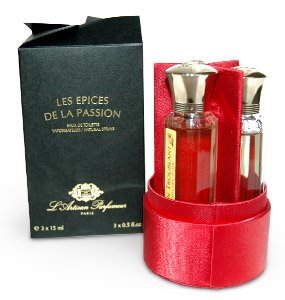
Part of the pleasure of L'Artisan Parfumeur's Les Epices trio is the presentation, which starts with the box. It's in matte black card stock, thin but not cheap, with gold print--the numero-uno way to show how classy you are (see also Estee Lauder's Spellbound and Dolce and Gabbana's Sicily, among many others). The top isn't the typical tab-and-slot closure, either; it's four flaps that tuck into one another, an abstract hint at the object inside. Inside that is a little leaflet containing typically breathless and giddy descriptions of the scents (in both English and French, nice touch) and the main event, a circular Chinese-red satin box. Lifting off the lid reveals three tiny 15-mL duplicates of the standard 50-mL L'Artisan bottle, but rescaled--they're not just miniatures, they're tall and slim and gorgeous. If every company made 15-mL bottles, that's all I'd ever buy, because I am never, ever going to use up most of what I have, but these are ideal.


Safran Troublant is translated to "Saffron Spell", but "troublant" actually means "disturbing", which, I assume, wasn't used because it has more than one meaning in English. The scent, like the other two, starts off as one thing and gradually becomes another, and in this case, the opening note is saffron, spicy and medicinal. I disliked Comptoir Sud Pacifique's Safranier because it was overloaded with that typically medicinal smell (the reason saffron in cooking has to be used with such discretion), but Safran Troublant gets it exactly right. Although there aren't any other spice notes listed, it seems to me that there's also a dose of clove in there.

Close behind the initial saffron note is a thrilling surprise--a full-bodied rose note which, although short-lived, is ravishing while it lasts. As with Piment Brûlant and Poivre Piquant, the saffron note is very slowly eclipsed by the secondary note, in this case vanilla, which percolates up and takes over until it's all that's left.

And that's the problem. The whole thing is beautiful, but the vanilla is, in fact, too much and not enough. There are so many vanilla scents on the market (L'Artisan already has one of the best, Vanilia) that this one seems, after the saffron has died away, rather ordinary. I still love Safran Troublant--the novelty of saffron and rose is what makes it work--but, like Piment Brûlant, it could have been more.

Labels: ,

Thursday, September 14, 2006

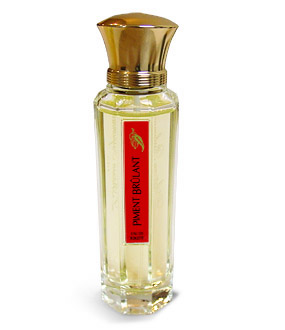
Slow Burn: L'Artisan Parfumeur Piment Brûlant


When I first tried the three scents in L'Artisan Parfumeur's Les Epices de la Passion, I was immediately smitten by Piment Brûlant; it smelled intoxicatingly of chocolate and it lasted just about forever on the skin.

It still does both those things, but something's changed. It's nice, but it's not amazing any more. Have I become habituated to chocolate scents (surrounded as I am by such things as CSP's Amour de Cacao, The Body Shop's Amorito, and Yves Rocher's Cocoon)? Has my nose changed? Has my skin?

Piment Brûlant--"burning-hot pepper"--starts out very red, with a rush of red pepper and a surprising floral note that, it turns out, is poppy. The poppy note vanishes in a matter of seconds, certainly less than a minute; the red pepper that remains is much softer and more muted than that in the top note of Givenchy's Xeryus Rouge (which is a startlingly crisp and realistic red pepper).

As is the case with all three Les Epices scents, another note wells up to join and finally subsume the top note, and in this case, it's chocolate, warm and only slightly sweet. This is clearly the scent of the concoctions that Vianne plies her customers with in Chocolat, and it's lovely.

But--and I can't believe I'm saying this--it's too simple. It needs more of something, and, not being a perfumer, I don't know exactly what. Spices? Vanilla? Something inedible such as ambergris? Whatever it is, isn't not there, and the complete lack of development after the chocolate note rises up makes the scent less than it ought to have been. (Poivre Piquant is equally simple, but the sharpness of the pepper and the complexity of the milky note make it work much better.) Piment Brûlant is still a pleasure to wear, but it could have been so much more.

Labels:

Tuesday, September 12, 2006

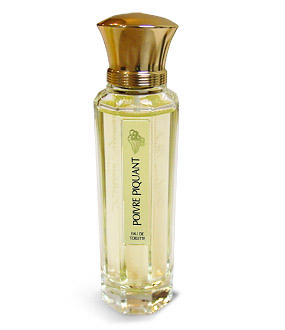
Dr. Pepper: L'Artisan Parfumeur Poivre Piquant


A few years ago, I did a fragrance swap with someone: I always like to throw in a bunch of samples, and luckily for me, they did, too, because I wound up with a set of three vials of the then-new collection by L'Artisan Parfumeur, "Les Epices de la Passion", three spice-based scents which manage to be subtle yet distinctive, gourmand yet unsweet, at the same time.

I liked all three, but was madly in love with one, Piment Brûlant, a heady blend of chocolate and red pepper. I used the three vials sparingly, but of course one day they ran out. I knew I had to own the set, and finally, earlier this year, I ordered it online. It's funny how your tastes change over time; the one that mesmerized me back then is now merely an appealing part of my collection, while the one I liked the least has become my favourite by far.

Poivre Piquant begins with a dust-dry surge of freshly-ground pepper, almost immediately joined by an equally powdery sprinkling of licorice root. The starkness, the aridity, of the top note is astounding. (It won't appeal to every taste: it probably won't appeal to many tastes at all.)

But the perfumer is not done: after grinding his spices before us, he slowly stirs them into a pot of hot milk, barely sweetened. The milky note--so similar to that at the base of the equally strange and fascinating Le Feu D'Issey--slowly rises up to envelop the hard edges of the pepper and the bitter-herbal licorice. From then on there's little development, just a slow cooking of the few carefully-chosen ingredients.

Complexity is a good thing in art, but sometimes utter simplicity is what we long for: sometimes less is more, and the stripped-down, intellectualized, flawless Poivre Piquant is the perfect illustration of that maxim.

Labels:

Wednesday, June 21, 2006

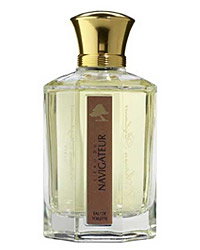
Sail Away: L'Artisan Parfumeur L'Eau du Navigateur


Quite some time ago, probably at least twelve years ago, Consumer Reports magazine reviewed fragrances for their Christmas issue. I thought it was a stupid idea: you can compare all the dishwashers on the market and come up with some sort of composite grade based on a number of factors, but how can you possibly do the same with scents, with over a thousand on the market, when the human nose is so variable and preferences so broad? You might as well try to rank all the paint chips at the hardware store in objective order of niceness.

They did eventually come up with a winner: their team of professional noses, smelling things blind, declared that Gio by Giorgio Armani was the best of all the scents they tried, mostly because it was the best-blended, meaning that no one note stuck out.

And that's all well and good, in its place, but sometimes you want things to stick out: you want Joy to smell like roses, not like some vague bouquet in which roses happen to be a component. I love it when something lunges out at you from time to time: it's fun to catch of a whiff of something specific and recognizable in a scent, to suddenly discover that in the middle of the sweet-vanilla scent of Chopard's Casmir is a little shot of coconut.

On the other hand, he said as he backtracked completely, sometimes you do want fragrances to be blended--to smell like a rich, smooth scent that's all of a piece and greater than the sum of its parts. That, to me, describes L'Artisan Parfumeur's Eau du Navigateur, which evokes a heavy-laden eighteenth-century cargo ship. ("Does it smell like sweaty men?" asked a friend when I described it to him. I suppose it could, if you play your cards right.)

Navigateur smells of wood, coffee, leather, tobacco, smoke, spices, and balsams: as I said, a cargo ship. What I love most about it is that to my nose, no one note really dominates. Some people find that one note or another is overwhelming: some call it a smoky scent, which it isn't compared to L'Artisan's Tea for Two, while others think of it as coffee-heavy. It strikes me as the perfect balance of all those masculine notes without being a leather scent or a tobacco scent or what have you. It's warm without being heavy (I wore it just today, the first day of summer), masculine without being overbearing, and--of course, as it's a L'Artisan scent--not quite like anything else on the market.

Labels:

Monday, March 13, 2006

Smoke Gets In Your Eyes: L'Artisan Parfumeur Tea for Two


About ten years ago I ordered a bunch of scents from a company called smell THIS!, which specialized, as Demeter still does, in unexpected real-world single-note scents: the company still exists, but their line is disappointingly attenuated. Back then, I ordered seven of their fragrances, and I can't believe I can still remember all of them: Popcorn (convincingly salty-buttery), Leather Jacket, Wet Laundry (remarkably wet-smelling), Mocha, Cake Batter (vanilla-laden yellow cake), Fresh Towels (after that wet laundry has been put through the dryer, I guess), and Campfire. The last was the only one I couldn't wear: it did smell like a smoky campfire, but one that someone had thrown a tire or some glossy magazines on--it was sickeningly resinous.

But a fragrance can be built around a smoky note and still work; it just can't be all about the smoke. L'Artisan Parfumeur's Tea for Two is, as the name tells you right off, based on tea, in this case Lapsang Souchong and smoked teas; but where tea scents (at least the ones I've tried) tend to be light and fresh, Tea for Two is dark and mysterious, adrift in curlicues of autumnal smoke. Everything else in the top and middle of the scent--whispers of spices such as cinnamon and ginger, a flash of citrus in the top--is just an adornment for the smokiness and the bristly warmth of the tea. Hours later--this is a very long-lasting scent which stays close to the skin--the smoke dissipates and leaves behind a haze of warm, woody vanilla. I expect there are people for whom the smell of smoke means only one thing ("FIRE!"), but for anyone with fond memories of a fireside pot of tea, Tea for Two is comfort in a bottle.

Labels: